Why durability matters in geological sampling
In geological industries, sustainability is no longer limited to environmental considerations alone. It also involves improving equipment lifespan, reducing maintenance operations, limiting industrial waste, and ensuring long-term operational reliability. In this context, the choice of materials used in geological equipment manufacturing becomes a strategic decision.
For many years, painted steel was widely used in industrial machine construction due to its lower manufacturing cost and ease of fabrication. However, geological sampling environments expose equipment to particularly aggressive operating conditions that quickly reveal the limitations of painted structures.
Core cutting and rock sample preparation operations continuously expose machines to water, lubrication systems, abrasive sludge, drilling fluids, humidity, and intensive cleaning procedures. Certain geological formations further increase these constraints. Sulfide-rich mining environments can create highly corrosive conditions for conventional metallic structures, while marine and offshore applications expose equipment to saline atmospheres that accelerate corrosion.
Under these conditions, painted surfaces progressively deteriorate due to abrasion, impacts, and repeated cleaning operations. Once the protective coating is damaged, corrosion can rapidly affect the structure of the equipment, leading to increased maintenance requirements and reduced machine lifespan.
At Geofactory, the transition from painted steel to stainless steel reflects a long-term sustainability approach focused on durability, operational reliability, and reduced environmental impact.
Stainless steel as a long-term sustainable solution
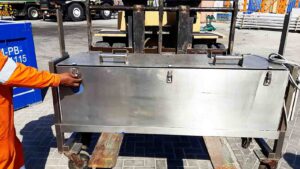
Unlike painted steel, stainless steel does not rely on an external protective coating to resist corrosion. Its corrosion resistance is directly linked to the material itself, allowing equipment to maintain structural integrity even in highly demanding environments.
Depending on the application and exposure level, Geofactory primarily uses 304 or 316 stainless steel. Stainless steel 304 provides excellent corrosion resistance for most geological and laboratory applications, while stainless steel 316 offers superior resistance in marine, offshore, and chloride-rich environments where corrosion risks are significantly higher.
This approach considerably improves equipment durability and reduces the frequency of maintenance operations. In a sustainability-driven industry, extending the operational life of machines becomes essential. Reducing equipment replacement frequency also limits raw material consumption, manufacturing demand, and industrial waste generation over time.
Stainless steel also provides important environmental advantages. The material is fully recyclable and eliminates the need for repeated repainting operations involving industrial coatings and volatile organic compounds (VOC). Reducing the use of these chemicals contributes directly to lowering the environmental impact of industrial equipment throughout its lifecycle.
Beyond durability, stainless steel also improves cleanliness and sample integrity in laboratory and oil & gas applications. Geochemical, petrophysical, and SCAL analyses require stable and controlled working environments where contamination risks must be minimized.
The non-porous surface of stainless steel simplifies cleaning operations and reduces residue accumulation after cutting processes. It is also less likely to release particles or contaminants that could alter sensitive geological samples during rock sample preparation workflows.
A sustainable vision beyond equipment performance
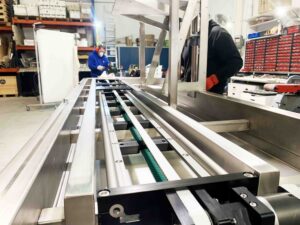
Sustainability also involves operational safety and long-term reliability. Corrosion does not only affect machine appearance. Over time, it can weaken structures, complicate maintenance procedures, and increase the risk of equipment failure.
By improving corrosion resistance, stainless steel helps maintain machine stability and facilitates preventive maintenance and inspection procedures. This reliability becomes particularly important in international geological projects where environmental conditions are severe and equipment downtime can significantly impact operations.
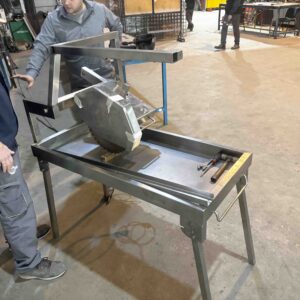
The use of stainless steel naturally represents a higher initial investment. Machining, welding, and finishing operations are generally more complex than with painted steel structures. However, this additional cost must be considered within a long-term operational perspective.
Equipment with higher durability, lower maintenance requirements, and improved resistance to harsh environments ultimately reduces overall operational costs. Lower maintenance frequency, reduced repainting operations, and extended machine lifespan progressively compensate for the higher initial investment.
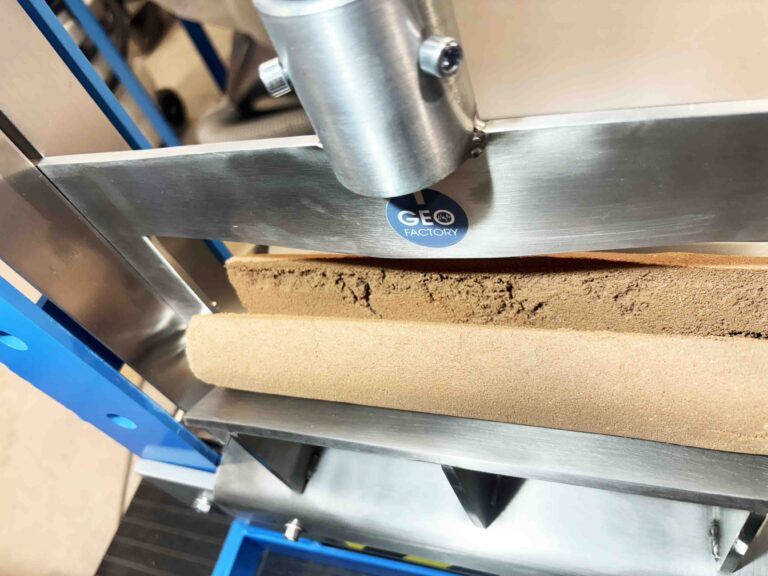
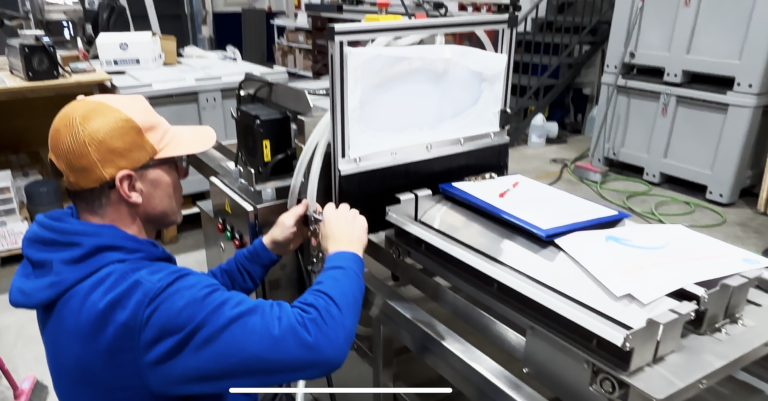
At Geofactory, the use of stainless steel reflects a broader design philosophy focused on developing reliable, durable, and field-adapted geological equipment. This approach aims to create machines capable of maintaining performance over many years while reducing environmental impact and long-term maintenance requirements.
Because in geological sampling, sustainability is not only about immediate machine performance. It is about designing equipment capable of remaining reliable, efficient, and operationally stable over the long term.