1 – NMR Analysis and the growing need for small-diameter core samples
In petrophysical laboratories, the quality of an analysis begins long before a sample is placed inside an analytical instrument. NMR (Nuclear Magnetic Resonance) analysis provides valuable information about the petrophysical properties of rocks, including porosity, pore structure and the fluids contained within the pore network. Today, NMR is increasingly integrated into advanced core analysis workflows alongside RCAL, SCAL and tomography techniques.
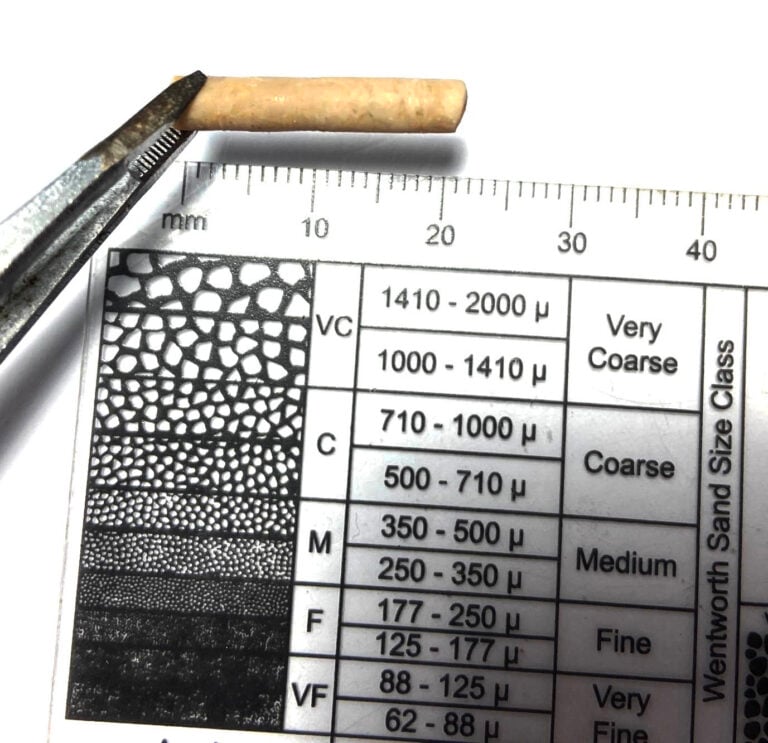
As analytical technologies become more precise, the requirements for geological sampling and rock sample preparation are also evolving. For certain NMR applications and research programs, laboratories need to characterize very small volumes of rock using small-diameter core samples, commonly referred to as micro-plugs.
Reducing sample dimensions offers several advantages. It allows laboratories to investigate highly localized areas within a geological core, select specific geological features and perform multiple analyses when only a limited volume of material is available. In heterogeneous formations, small-diameter core sampling can also help isolate zones with specific mineralogical, petrophysical or structural characteristics.
However, reducing the diameter of a core plug fundamentally changes the sample preparation process. As dimensions decrease, the precision of the sampling operation becomes increasingly important.
Sample representativeness and sample integrity therefore become critical parameters. A microfracture generated during extraction, incorrect geometry or alteration of the internal rock structure may influence subsequent measurements.
Small-diameter core sampling is consequently becoming a highly specialized area of modern rock sample preparation.
2 – When a few millimetres become a core preparation challenge
Preparing conventional core plugs is a standard operation in many petrophysical laboratories. However, when the sample diameter is progressively reduced to only a few millimetres, the mechanical challenges increase considerably.
Diamond tooling alignment, rotational speed, feed rate, vibration, heat generation and the mechanical forces applied to the rock must all be carefully controlled. At this scale, even a small deviation during core plugging may be sufficient to fracture the sample or produce a micro-plug with unsuitable geometry.
The difficulty also depends strongly on the geological formation being sampled.
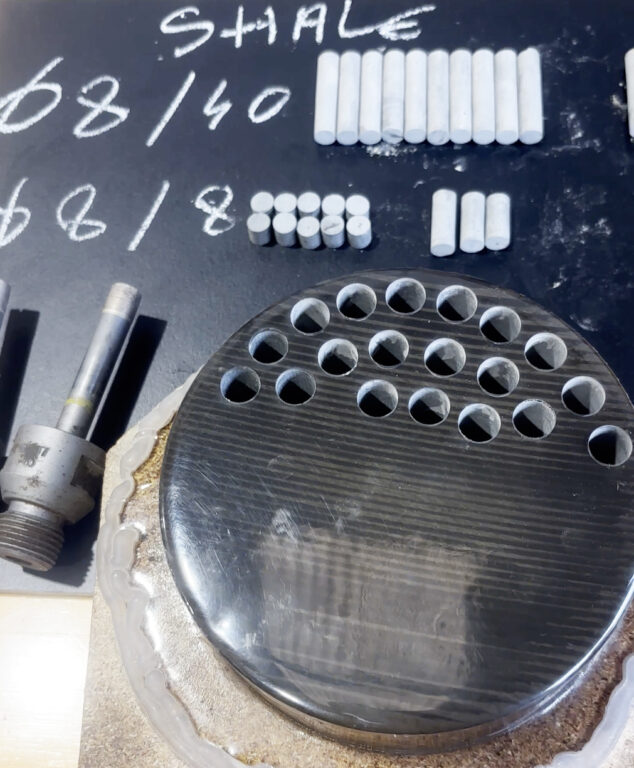
Shale represents a particularly challenging material. Its natural anisotropy, laminated structure and mechanical behaviour can promote cracking or delamination during small-diameter core extraction. As the diameter decreases, preserving the original internal structure becomes progressively more difficult.
Salt formations, particularly halite, present a different set of challenges. Their mechanical behaviour and sensitivity to certain fluids require careful consideration of both the diamond tooling and the sampling method. With these sensitive geological formations, the objective is not simply to extract a small cylinder of rock. The priority is to preserve a representative sample for the petrophysical analyses that follow.
As part of its development work, Geofactory has successfully prepared cylindrical geological samples down to only 2 mm in diameter while maintaining a 1:2 diameter-to-length ratio. At these dimensions, controlling diamond tooling, sampling parameters and sample holding becomes critical to successful micro-plug recovery.
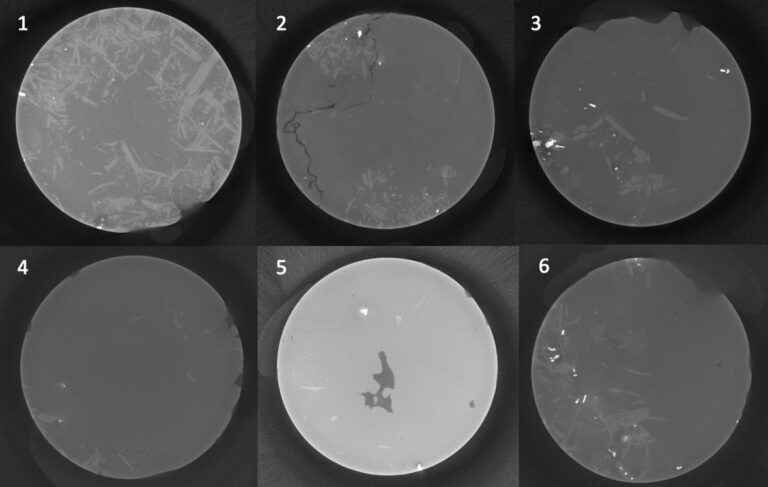
These micro-plugs create interesting opportunities for NMR analysis, Micro-CT and tomography, as well as advanced research programs requiring the characterization of extremely small rock volumes. They can also enable researchers to investigate very specific areas of a core when the available geological material is limited.
The challenge is therefore no longer simply to reduce sample diameter. It is to reduce it while maintaining dimensional accuracy, sample integrity and the geological representativeness of the material.
3 – From the laboratory to the wellsite: Bringing micro-sampling closer to fresh Core
The development of small-diameter core sampling raises another important question: why wait until the geological core reaches the laboratory before extracting certain micro-samples?
For some Oil & Gas applications, particularly during the core processing of shale formations, extracting micro-plugs directly from fresh core could significantly shorten the workflow between core recovery, geological sampling, sample preparation and NMR analysis.
This is one of the development areas currently being investigated by Geofactory.
For the past few months, our engineering team has been testing different diamond tooling configurations combined with a compact pneumatic drive system adapted to the requirements of ATEX environments. The objective is to investigate a portable small-diameter core sampling solution that could operate directly at the wellsite while remaining compact enough to be easily mobilized and transported in a case.
This approach could be particularly relevant for shale samples. Working directly with fresh core material would bring sample preparation closer to the core recovery stage and could accelerate the analytical workflow before samples reach the petrophysical laboratory.
The project remains under development. The final configuration has not yet been defined, and several technical parameters still need to be investigated. Different geological formations exhibit very different mechanical behaviours, while successful micro-plug recovery depends on diamond tooling, drilling parameters, sample holding and the physical properties of the rock.
This research reflects a broader evolution in geological sampling. As NMR, Micro-CT, tomography and advanced core analysis technologies enable scientists to characterize increasingly smaller volumes of rock, sample preparation methods must evolve at the same pace.
For Geofactory, the objective is therefore not simply to manufacture equipment capable of producing smaller samples. It is to develop new rock sample preparation methods that bring sampling closer to analysis, work with geological material in the most representative condition possible and preserve the integrity of the micro-sample throughout the process.
As analytical technologies allow us to investigate rocks at increasingly finer scales, just a few millimetres of geological material can now contain a remarkable amount of information. YouTube channel