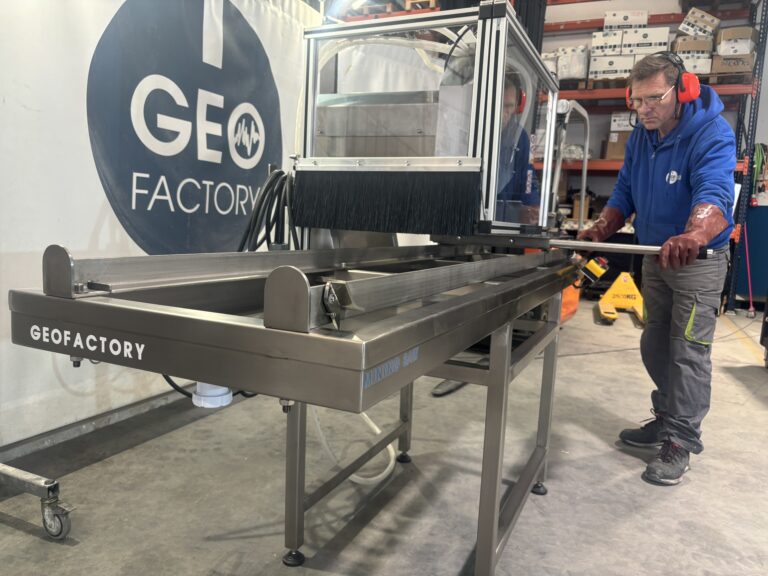
In geological sampling projects, choosing the right Core Saw is a critical decision. It directly impacts sample quality, cutting precision, operator safety, and overall productivity. With a wide range of applications—from mining and oil & gas to geotechnical, laboratory, and field exploration—there is no one-size-fits-all solution.
At Geofactory, several Core Saw solutions are designed to meet specific operational needs: the Mining Core Saw, Slabbing Saw 500, Explo Core Saw, and Dual-Axis Saw. The objective is not to compare machines, but to identify which solution best fits your geological application and workflow.
Understanding Your Application Before Choosing
Selecting the right Core Saw starts with a clear understanding of your operational context. Key parameters include the type of project (exploration, production, laboratory), core diameter—ranging from AQ to PQ in mining and oil & gas, up to 165 mm in certain applications, and up to 260 mm in geotechnical projects—as well as core length and condition (fractured, abrasive, or sensitive).
The working environment is equally important. Field operations require mobility and ease of deployment, while laboratory environments demand precision, stability, and control. Production volume must also be considered, whether handling occasional samples or high-throughput core cutting operations.
The right choice depends on how well the Core Saw integrates into your geological sampling workflow.
Mining Core Saw: Robustness for High-Volume Production
The Mining Core Saw is designed for intensive use in structured environments such as mining laboratories and industrial facilities. It handles core diameters from AQ to PQ, with lengths up to 60 cm.
Its robust design, high power, and cutting stability ensure excellent repeatability, even under demanding conditions. This makes it ideal for high-volume geological sampling where productivity and reliability are essential.
This solution is particularly suited for continuous core cutting operations with consistent performance requirements.
Slabbing Saw 500: Precision for Large Core Samples and Oil & Gas Applications
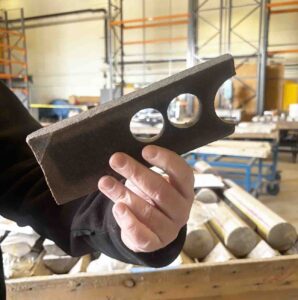
The Slabbing Saw 500 is designed for applications requiring high precision and the ability to process large core samples, up to 165 mm in diameter and up to 1 meter in length. It also allows adjustable transverse cuts, such as 50/50 or 1/3–2/3 (biscuit slice), depending on analytical requirements.
Its fully enclosed structure, combined with integrated safety systems, ensures a controlled cutting environment. It is particularly suited for advanced laboratory applications, including SCAL, where cutting accuracy and repeatability are critical.
It is also an ideal solution for oil & gas sampling, where preserving rock sample integrity and achieving precise core cutting are essential for reliable analysis.
Explo Core Saw: Mobility for Field Operations
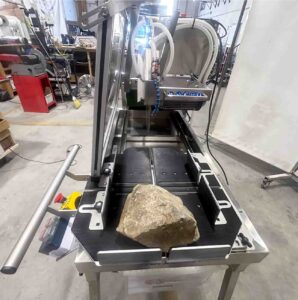
The Explo Core Saw is designed for portability and flexibility. It enables core cutting directly on-site, making it particularly suitable for exploration projects and remote environments.
It supports AQ to PQ core samples up to 50 cm in length and is easy to transport and install. Despite its compact design, it delivers reliable performance for field-based rock sample preparation.
This solution is ideal when mobility and fast deployment are key operational requirements.
Dual-Axis Saw: Flexibility for Advanced Sample Preparation and Research
The Dual-Axis Saw is designed for complex cutting operations requiring high geometric precision. It allows multi-axis cutting, providing full control over sample orientation and preparation.
This solution is particularly relevant for laboratories requiring advanced sample preparation or specific cutting geometries for detailed analysis.
It is also highly suited for research institutes and universities, where a wide range of departments work with non-conventional samples. Applications such as paleomagnetism, rock mechanics, and other experimental fields require precise and reproducible sample preparation, which the Dual-Axis Saw enables.
This makes it an ideal solution for technical applications requiring flexibility, precision, and adaptability.
Key Criteria for Making the Right Choice
Choosing the right Core Saw depends on several factors:
- Production volume and throughput requirements
- Type of geological formation (abrasive, fractured, sensitive)
- Core diameter and length
- Need for mobility versus fixed installation
- Required level of precision
- Complexity of cutting operations
- Available infrastructure (power supply, water, workspace)
Each geological sampling project presents unique constraints, and the selected equipment must align with these requirements.
Conclusion
There is no universal Core Saw. Each geological application comes with its own constraints, and the equipment must be selected accordingly.
At Geofactory, our approach is to understand your specific needs in order to recommend the most suitable Core Saw solution. Whether for high-volume geological sampling, precision laboratory work, or field operations, each machine is designed to match a defined application.
Choosing the right Core Saw goes beyond the machine itself. It also requires selecting the appropriate supporting equipment, including the right diamond blade based on the rock type, as well as the correct lubrication system. These elements play a critical role in ensuring cutting performance, reducing tool wear, and maintaining consistent results.
Optimizing core cutting operations depends on this global approach—combining the right geological equipment, proper rock sample preparation methods, and adapted cutting parameters.
This is what ultimately ensures reliable, precise, and repeatable results in geological sampling workflows.